Introduction
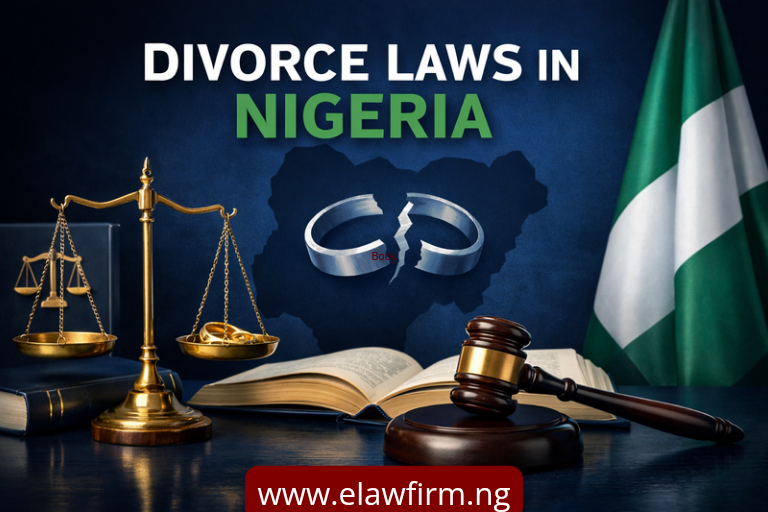
Divorce law in Nigeria is not unified. The country recognizes different types of marriage, and each type is regulated by its own distinct legal framework. As a result, the process for dissolving a marriage depends entirely on the form of marriage contracted by the parties.
A clear understanding of the laws governing the dissolution of marriage is essential to the success of any divorce petition. Where the wrong legal procedure is adopted, the divorce may be rendered invalid, regardless of how long the parties have lived apart or how settled the separation appears.
This article examines the various laws that regulate divorce proceedings in Nigeria and explains how to identify the correct legal pathway.
- Introduction
- Which law governs my marriage in Nigeria?
- What are the recognised types of marriage under Nigerian law?
- Which court has jurisdiction over my divorce?
- Can a customary or Islamic marriage be dissolved under statutory law?
- What happens if the wrong divorce process is used?
- Does long separation automatically end a marriage in Nigeria?
- Can I remarry if my divorce was done under the wrong law?
- What law applies where both customary rites and a registry or church wedding were done?
- Why understanding the correct divorce law matters
- Frequently Asked Questions on Divorce Laws in Nigeria
Which law governs my marriage in Nigeria?
The law that governs your divorce is determined by the type of marriage you contracted, not by how the relationship ended or how long you have been separated.
In Nigeria, marriages fall into three broad categories:
- Statutory marriage
- Customary marriage
- Islamic marriage
Each category has its own rules, courts, and procedures for dissolution. Before considering divorce, the first and most important question is identifying which type of marriage exists in law.
What are the recognised types of marriage under Nigerian law?
Statutory marriage
This is a marriage celebrated under the Marriage Act, usually at a marriage registry or a licensed place of worship, followed by the issuance of a marriage certificate. It is also known as marriage under the Act and often loosely referred to as ‘the court marriage.’ Once a marriage is statutory, it can only be dissolved through the High Court of a state or the High Court of the Federal Capital Territory under the Matrimonial Causes Act.
Customary marriage
This is a marriage conducted according to native law and custom, often involving traditional rites, bride price, and family consent. Divorce under customary law follows the customs of the parties, which is often by return of bride price under many customs. it is handled by a Customary Court or Area Court.
Islamic marriage
This is a marriage conducted under Islamic law. Divorce is regulated by Islamic principles and handled by a Sharia Court where applicable.
Which court has jurisdiction over my divorce?
Jurisdiction depends strictly on the nature of the marriage.
- Statutory marriage: The High Court of a State or the Federal Capital Territory is the appropriate court that has jurisdiction to dissolve a statutory marriage1.
- Customary marriage: Customary marriage can be dissolved informally under various customs without approaching the court by the refund of bride price or by filing a petition for dissolution of customary marriage in the Customary Court with jurisdiction over the area where the parties reside.
- Islamic marriage: Sharia Court in States where Sharia law operates.
Filing in the wrong court does not merely delay the process. It can invalidate the entire divorce on the grounds of lack of jurisdiction.
Can a customary or Islamic marriage be dissolved under statutory law?
No. A customary or Islamic marriage cannot be dissolved under the Matrimonial Causes Act unless it has been converted into a statutory marriage by the parties proceeding to contract a statutory marriage after their Islamic or customary marriage. If a marriage remains customary or Islamic in law, it must be dissolved under the appropriate customary or Islamic legal framework.
What happens if the wrong divorce process is used?
Using the wrong legal process can have serious consequences. Some of the consequences include:
- The divorce may be legally invalid.
- Any subsequent marriage may be void.
- Property settlements may be challenged.
- Issues of inheritance and custody may arise years later.
Time, separation, or mutual agreement does not cure a defective divorce process. You cannot place something on nothing and expect it to stand.
Does long separation automatically end a marriage in Nigeria?
No. Separation, regardless of duration, does not amount to divorce under Nigerian law. This is so irrespective of the type of marriage you contracted.
Parties may live apart for ten or twenty years, but until a competent court or recognised customary or Islamic process formally dissolves the marriage, it remains legally valid. For further insight, please read our article on the difference between divorce and separation, case law insight.
Can I remarry if my divorce was done under the wrong law?
A remarriage based on an invalid divorce is legally unsafe. Such a marriage may be void, and this can affect:
- Immigration applications
- Succession and inheritance rights
- Spousal benefits and pensions
- Legitimacy of subsequent marital claims
This risk is particularly common among Nigerians in the diaspora who rely on informal or incorrect divorce procedures. For a deeper understanding of void marriages and their effect, please read our article on void marriages in Nigeria.
What law applies where both customary rites and a registry or church wedding were done?
Where customary marriage is followed by a valid statutory marriage, the marriage becomes statutory in law. Divorce must then be pursued under the Matrimonial Causes Act at the High Court.
However, not every church or ceremonial wedding amounts to a statutory marriage. Legal validity depends on compliance with statutory requirements, not appearance or ceremony. According to the Court of Appeal in the case of Motoh vs. Motoh (2011) 16 NWLR (Pt. 1274) 474:
For a celebration in a church to constitute a marriage under the Marriage Ordinance or Marriage Act, it must be in a licensed place of worship, by a recognized minister of the church, and in accordance with the marriage rites and usages of the church
This distinction is critical and often misunderstood. To clear any doubt on the status of your church marriage, please read our article on legal status of a church marriage.
Why understanding the correct divorce law matters
Divorce in Nigeria is not a matter of convenience or personal preference. It is a matter of strict legal alignment with the nature of the marriage contracted. Understanding the correct legal foundation protects parties from future disputes, invalid remarriage, and avoidable legal exposure.
Frequently Asked Questions on Divorce Laws in Nigeria
This requires examining how the marriage was conducted, the documents issued, and whether statutory requirements were met. Legal review is often necessary to avoid costly mistakes.
The most common mistake is using the wrong court or legal framework. This error often surfaces years later, when remarriage, inheritance, or immigration issues arise.
Yes. Divorce can be initiated from abroad, but it must still follow the correct Nigerian legal process and be filed in the appropriate court with jurisdiction.
Yes. Payment of bride price does not prevent a marriage from becoming statutory if the parties later contracted a valid marriage under the Marriage Act. However, without such conversion, the marriage remains customary.
Conclusion
Divorce in Nigeria is not governed by a single, uniform law. It is regulated by different legal systems, each tied strictly to the nature of the marriage contracted. This distinction is not technical or cosmetic. It determines the applicable law, the proper court, and the validity of the entire divorce process.
Understanding whether a marriage is statutory, customary, or Islamic is therefore the foundation of any lawful divorce. Where this foundation is misunderstood or ignored, parties expose themselves to serious legal risks, including invalid divorce, unsafe remarriage, and future disputes over property, children, or inheritance.
For anyone considering divorce, or already separated, the most important step is ensuring that the process aligns precisely with the law governing the marriage. That alignment is what makes a divorce legally effective and future-proof. Where clarity is required, professional guidance is not optional. It is protective.
If you need assistance reviewing your marriage status, choosing the correct court, or handling divorce proceedings properly, our divorce law services are designed to guide you through the process with precision and discretion. you can also call or send sms to +2349045532566
Legal Disclaimer
This article is provided for general information and educational purposes only. It does not constitute legal advice and should not be relied upon as a substitute for professional legal consultation. Divorce matters are fact-specific, and the applicable law may vary depending on individual circumstances. Readers are advised to seek tailored legal advice before taking any step based on the information contained in this article.

- Section 2(1) of the Matrimonial Causes Act ↩︎