Introduction
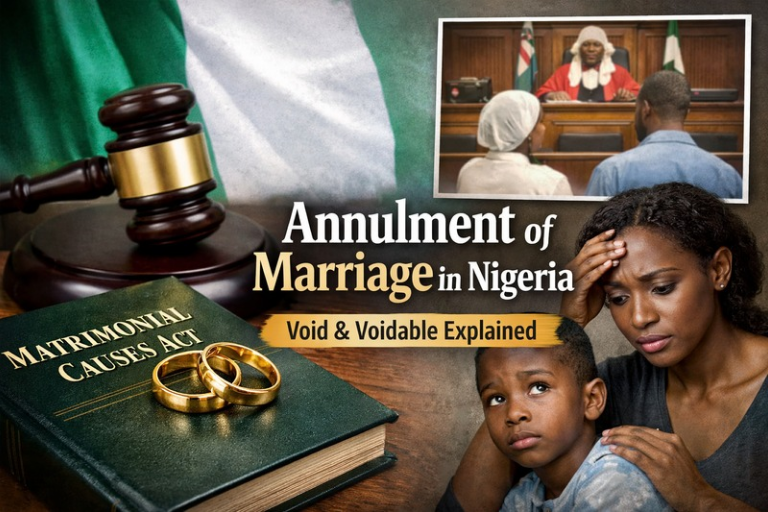
Annulment of marriage in Nigeria is totally different from divorce in Nigeria. Unfortunately, many people still assume that divorce is the only legal exit from a marriage, even where the marriage itself was defective from the beginning.
Ignorance of the difference between annulment of marriage and divorce could be desastrous.
This article explains annulment of marriage in Nigeria in clear and practical terms. It answers the real questions people ask online, explains the difference between annulment and divorce, clarifies void and voidable marriages as grounds for annulment, sets out the legal process for obtaining a decree of nullity, and explains what happens to children and property afterward.
- Introduction
- What Is Annulment of Marriage in Nigeria?
- Is Annulment the Same as Divorce in Nigeria?
- What is the Ground For Annulment of Marriage In Nigeria?
- How Do You Get an Annulment of Marriage in Nigeria?
- What Happens to Children After Annulment of Marriage in Nigeria?
- What Happens to Property, Children, and Maintenance After Annulment of Marriage in Nigeria?
- Should I Choose Annulment of Marriage in Nigeria or Divorce?
- Frequently Asked Questions
What Is Annulment of Marriage in Nigeria?
Annulment of marriage in Nigeria is a court process by which a marriage is declared legally invalid. Legally invalid marriage could be likened to a building with very faulty foundation. The court issues a decree of nullity, stating that the marriage was either void from inception or voidable and successfully challenged.
Annulment does not address marital breakdown. It addresses legal validity. Where annulment is granted, the law treats the marriage as though it never existed, subject to statutory protections for children and property.
The legal basis for annulment is found in section 34 of the Matrimonial Causes Act, which provides:
“A petition under this Act for nullity of marriage may be based on the ground that the marriage is void or on the ground that the marriage is voidable at the suit of the petitioner.”
Is Annulment the Same as Divorce in Nigeria?
No. Annulment is not the same as divorce in Nigeria. Divorce applies only where the marriage was validly contracted, but has broken down irretrievably either due to adultery, living apart, or any other fact that could lead to divorce. On the other hand, annulment applies where the marriage itself is legally defective.
Divorce is governed by section 15(1) of the Matrimonial Causes Act, which states:
“The court shall not grant a decree of dissolution of marriage unless it is satisfied that the marriage has broken down irretrievably.”
The difference is clearer when placed side by side:
- The legal basis for annulment of marriage is on the basis of a claim of legal defect at the inception of the marriage. Whereas, the legal basis of divorce is based on the claim that the marriage, although valid, has irretrievably broken down.
- If a petition for divorce is successful, the court will make a decree nisi dissolving the marriage. In the case of a petition for annulment of marriage, the court declares the marriage invalid and makes a decree of nullity of marriage. The spouses thereafter revert to their single status. This is in contrast with divorce, where parties are referred to as divorcees after the decree nisi becomes absolute.
- The only ground for dissolution of a statutory marriage is on the ground that the marriage has broken down irretrievably. However, the grounds for annulment of marriage are on the ground that the marriage is void or voidable.
Are you unsure about the difference between divorce and legal or judicial separation? Gain clarity from our article on difference between separation and divorce in Nigeria
What is the Ground For Annulment of Marriage In Nigeria?
According to Section 34 of the Matrimonial Causes Act, a petition for nullity of marriage may be based on the ground that the marriage is void or on the ground that the marriage is voidable. So, a court can make an order annulling a marriage if it is proved to the satisfaction of the court that the marriage is void or voidable.
What Makes a Marriage Void Under Nigerian Law?
A marriage is void under Nigerian law where it is invalid from the outset. The defect goes to the root of the marriage and renders it incapable of producing a lawful union.
Under section 3(1) of the Matrimonial Causes Act, a marriage celebrated after the commencement of the Act is void in any of the following cases, but not otherwise:
- Either of the parties is, at the time of the marriage, lawfully married to some other person. This is often the most common incident of void marriage in practice. Most people who contracted statutory marriage often believe that decree nisi means that they are free to remarry. They end up remarrying before the decree nisi becomes absolute. This unfortunately makes their second marriage void.
- The parties are within the prohibited degrees of consanguinity or affinity.
- The marriage is not a valid marriage under the law of the place where the marriage was celebrated.
- The consent of either of the parties is not a real consent, because it was obtained by:
- duress or fraud,
- mistake as to the identity of the other party, or
- mistake as to the nature of the ceremony performed.
- Either of the parties is mentally incapable of understanding the nature of the marriage contract.
- Either of the parties is not of marriageable age.
These grounds are exhaustive.
Where any of these defects exists, the marriage is void ab initio and constitutes a proper ground for annulment of marriage in Nigeria. For a deeper insight on void marriage, read our article on void marriages in Nigeria.
What Makes a Marriage Voidable Under Nigerian Law?
A marriage is voidable where it is presumed valid unless and until it is annulled by a court. Unlike a void marriage, a voidable marriage remains legally effective until successfully challenged.
Under section 5(1) of the Matrimonial Causes Act, a marriage is voidable only on the following grounds:
- Either party to the marriage is incapable of consummating the marriage.
- Either party to the marriage is of unsound mind, is a mental defective, or is subject to recurrent attacks of insanity or epilepsy.
- Either party to the marriage is suffering from venereal disease in a communicable form.
- The wife was pregnant by a person other than the husband at the time of the marriage.
These grounds are also exhaustive.
However, annulment of a voidable marriage is subject to statutory limitations. Under sections 35 to 37 of the Matrimonial Causes Act, the court shall refuse a decree of nullity where:
- The petitioner knew of the defect at the time of the marriage.
- The petition was not presented within twelve months of the marriage in cases involving mental incapacity, venereal disease, or pregnancy by another man.
- Marital intercourse took place with the petitioner’s consent after discovery of the defect.
- The court considers it unjust, oppressive, or contrary to public interest to grant the decree.
How Do You Get an Annulment of Marriage in Nigeria?
To obtain annulment of marriage in Nigeria, a petition for nullity of marriage must be filed at the High Court of a State or the High Court of Federal Capital Territory.
The petitioner must plead and prove facts showing that the marriage is void or voidable. Relevant documents, including the marriage certificate where available, are attached. The respondent is served and given an opportunity to respond.
Where the court is satisfied that the marriage is legally defective, it grants a decree of nullity.
Unlike divorce, there is no requirement to prove irretrievable breakdown. The focus remains strictly on validity.
What Happens to Children After Annulment of Marriage in Nigeria?
Children born of a void or voidable marriage remain legitimate under Nigerian law.
Section 38(2) of the Matrimonial Causes Act provides:
“A decree of nullity of a voidable marriage shall not render illegitimate a child of the parties born since, or legitimated during, the marriage.”
Annulment does not affect their status, rights of inheritance, or entitlement to maintenance.
What Happens to Property, Children, and Maintenance After Annulment of Marriage in Nigeria?
Although annulment treats the marriage as invalid, the court retains power to make orders relating to property, maintenance, custody and financial relief.
Section 69 of the Matrimonial Causes Act defined ‘marriage’ to included purported marriage that is void. This simply means that even where the marriage is considered to be invalid, the invalidity of the marriage has nothing to do with child custody, division of property and maintenance.
Sections 70 to 72 of the Matrimonial Causes Act empower the court to make property and maintenance orders even where a marriage is annulled.
Contributions made during the relationship are not automatically ignored. The court may intervene to prevent unfair outcomes.
Our article on Child custody in Nigeria, explained with decided cases how Nigerian courts decided child custody cases.
Should I Choose Annulment of Marriage in Nigeria or Divorce?
The correct choice depends on legal validity, not emotional dissatisfaction.
If the marriage was defective from inception or became vulnerable due to recognized statutory grounds, annulment of the marriage in Nigeria is appropriate. If the marriage was valid but has broken down irretrievably, divorce is the proper legal route.
For those outside Nigeria, our divorce page explains how you can successfully handle your petition virtually without physical presence in Nigeria.
Frequently Asked Questions
Annulment of marriage in Nigeria is a court process where a marriage is declared legally invalid because it was void or voidable under the Matrimonial Causes Act.
No. Divorce ends a valid marriage that has broken down irretrievably. Annulment declares that the marriage was legally defective from the beginning.
The only grounds for annulment are that the marriage is void or voidable, as expressly provided under sections 3 and 5 of the Matrimonial Causes Act.
There is no fixed timeline. The duration depends on the court’s schedule, service of court processes, and whether the petition is contested.
You should file for annulment only if the marriage was legally defective. If the marriage was valid but has broken down irretrievably, divorce is the correct legal option.
Finally, annulment and divorce serve different legal purposes under Nigerian law. Understanding annulment of marriage in Nigeria helps you choose the correct process, protect your children, and avoid costly procedural errors. Where uncertainty exists, clarity should come before court action.
For inquiries on annulment of marriage or other family, property, and inheritance law-related issues, call or send WhatsApp to +2349045532566. you can equally visit
This article is strictly for educational purposes and not a legal advice. For legal advice, kindly consult with a family lawyer.