Introduction
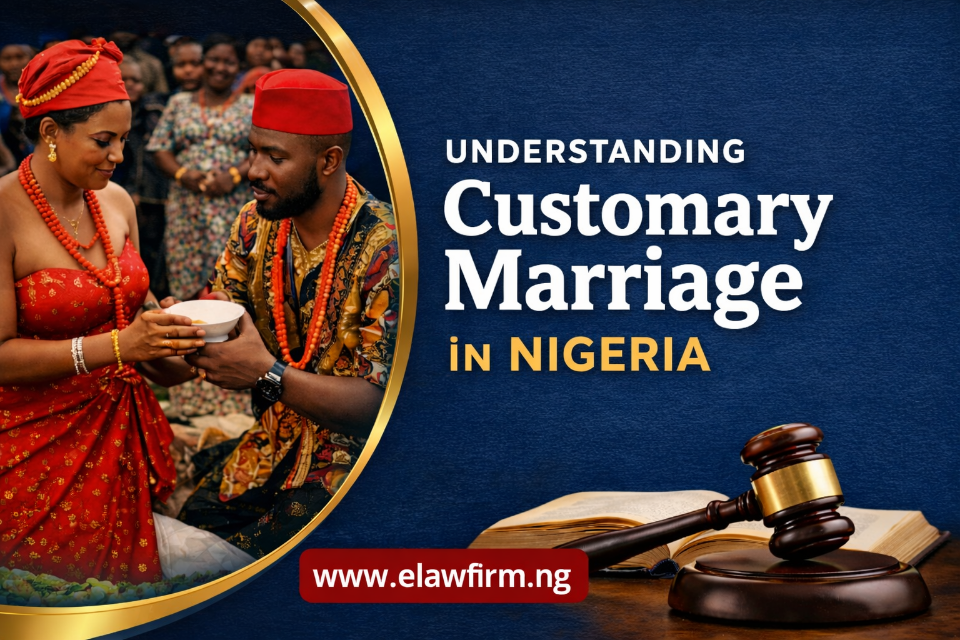
Customary marriage in Nigeria remains one of the most widely practised forms of marriage. Across many Nigerian communities, marriage is celebrated according to the customs and traditions of the parties involved. Families meet, a bride price is negotiated, and traditional rites are performed before the bride is formally handed over to the husband’s family.
Nigerian law recognises customary or traditional marriages as valid marriages if the essential requirements of customary law are satisfied. The courts have repeatedly affirmed that customary marriages form part of the recognised legal framework of marriage in Nigeria.
Because customary marriage operates under native law and custom rather than statutory legislation, questions often arise about its validity, proof, and dissolution. Understanding the legal principles governing customary marriage is therefore essential for anyone dealing with family law issues in Nigeria and this article will explain these and more.
- Introduction
- What Is Customary Marriage in Nigeria?
- What Are the Requirements for a Valid Customary Marriage in Nigeria?
- Customary vs Statutory Marriage in Nigeria
- Is Customary Marriage Legal in Nigeria?
- How Can Customary Marriage Be Proved in Nigeria?
- Can a Person in a Customary Marriage Contract a Statutory Marriage?
- How Is Customary Marriage Dissolved in Nigeria?
- Limits of Customary Marriage
- Conclusion
What Is Customary Marriage in Nigeria?
Customary marriage in Nigeria is a marriage conducted in accordance with the native law and custom of the parties involved.
Nigeria operates a plural legal system which recognises statutory law, customary law, and Islamic law. Marriage celebrated under customary law is therefore legally valid where the custom itself is not repugnant to natural justice, equity, or good conscience.
The courts have recognised customary marriage as a legitimate form of marriage provided the relevant customary requirements are satisfied.
For example, in the case of Nsirim v. Nsirim (1995) 9 NWLR (Pt. 418) 144 (CA), the Court of Appeal explained that while communities may have different details of customary marriage, certain broad principles are generally shared across Nigerian customs.
The court stated that:
“There are essential and formal requirements for the celebration of a valid customary law marriage. The details may vary from one locality to another but the broad principles are sometimes similar.”
This judicial position reflects the flexible nature of customary law across Nigeria’s diverse ethnic groups.
What Are the Requirements for a Valid Customary Marriage in Nigeria?
Although customs vary across Nigeria, Nigerian courts have identified certain essential elements for a valid customary marriage.
These generally include:
Capacity of the parties to marry
Consent of the parties and their families
Payment of bride price
Performance of customary marriage rites
The Court of Appeal clearly identified these requirements in Nsirim v. Nsirim (1995) 9 NWLR (Pt. 418) 144 (CA) where the court held that the essential elements of a valid customary marriage include:
1. capacity of the parties
2. payment of dowry or bride price
3. celebration of the marriage ceremony
4. handing over of the bride to the husband’s family.
Similarly, Nigerian courts have emphasised that bride price plays a central role in many customary marriages.
In Salubi v. Nwariaku (2003) 7 NWLR (Pt. 819) 426 (CA), the court observed that payment of bride price remains an important indicator that a customary marriage has been properly contracted under the relevant custom.
Customary vs Statutory Marriage in Nigeria
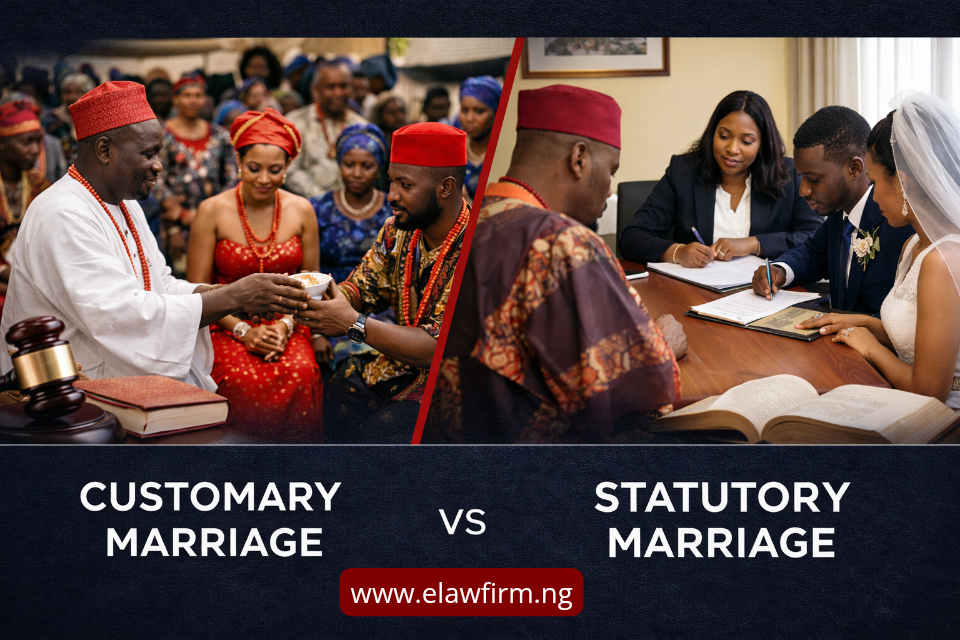
Nigerian law recognises two principal systems of marriage.
The first is statutory marriage. This is a type of marriage celebrated in line with the provisions of the Marriage Act. It is often celebrated in a marriage registry or licensed place of worship and it is monogamous in nature. Under Section 21 of the Marriage Act, a marriage may be celebrated in a licensed place of worship by a recognised minister, with open doors and in the presence of at least two witnesses besides the officiating minister. Statutory marriage can only be dissolved by a High Court of a State or the High Court of the Federal Capital Territory, Abuja.
The second is customary/ Islamic marriage. Customary marriage is governed by native law and custom and may allow polygamy depending on the applicable tradition.
Nigerian courts have considered the legal consequences of contracting a statutory marriage after a customary marriage.
In Jadesimi v. Okotie-Eboh (1996) 2 NWLR (Pt. 429) 128 (SC), the Supreme Court held that where the same parties who first married under customary law subsequently contract a marriage under the Marriage Act, the statutory marriage converts the potentially polygamous customary marriage into a monogamous statutory marriage.
The above decision clearly illustrates that once you proceed to further contract a statutory marriage with your spouse with whom you had earlier contracted a customary law marriage with, the effect of the second marriage is that it turns your union into a statutory marriage. Polygamy, which is obtainable under customary marriage, is no longer permitted.
It is important to note that you can only contract a subsequent statutory marriage with the same person you had earlier contracted a customary marriage with. If the later statutory marriage is contracted with a different person without dissolving the earlier customary marriage, that could make you liable for bigamy.
Is Customary Marriage Legal in Nigeria?
Yes. Customary marriage is legally recognised under Nigerian law.
The clearest statutory support is again found in section 35 of the Marriage Act, which states that nothing in the Act shall affect the validity of any marriage contracted under or in accordance with customary law.
The Supreme Court also recognised the legitimacy of customary marriage structures in Chinweze v. Masi (1989) 1 NWLR (Pt. 97) 254 (SC).
In that case, the court acknowledged that under Nigerian customary law, a family may consist of one wife in a monogamous union or several wives under customary marriage.
This judicial recognition confirms that customary marriage forms an integral part of Nigeria’s recognised marriage system.
How Can Customary Marriage Be Proved in Nigeria?
Because customary marriages are often not documented, proof of the marriage frequently depends on oral evidence and testimony regarding the performance of traditional rites.
Where a statutory marriage is celebrated, the position is different. Section 32 of the Marriage Act provides that every certificate of marriage filed in the office of the registrar, or a certified copy of it, and every entry in the marriage register book, shall be admissible as evidence of the marriage in court.
Customary marriages, however, often do not come with this kind of official documentary trail. That is why courts usually rely on witnesses who attended the ceremony or took part in the marriage negotiations.
This principle was emphasised in Akinsanya v. Longman (1996) 9 NWLR (Pt. 473) 173, where the court held that a party relying on a customary marriage must prove that the relevant customary rites were performed.
Evidence may include testimony about the payment of bride prices, the participation of family representatives, the performance of marriage ceremonies, and the handing over of the bride to the husband’s family.
Can a Person in a Customary Marriage Contract a Statutory Marriage?
A person already married under customary law must exercise caution before contracting another marriage under the Marriage Act.
Section 33(1) of the Marriage Act provides that no marriage in Nigeria shall be valid where either of the parties, at the time of the celebration of the marriage, is married under customary law to any person other than the person with whom the marriage is had.
In addition, section 46 of the Marriage Act makes it an offence for a person to contract a marriage under the Act while already married under customary law to another person. The punishment stated there is imprisonment for five years.
The legal effect of contracting a statutory marriage after a customary marriage between the same parties was examined by the Supreme Court in Jadesimi v. Okotie-Eboh (1996) 2 NWLR (Pt. 429) 128 (SC).
The court held that where the same parties who contracted a customary marriage later marry under the Marriage Act, the statutory marriage supersedes the customary marriage and converts it into a monogamous marriage recognised under statutory law.
How Is Customary Marriage Dissolved in Nigeria?
The dissolution of customary marriage differs significantly from the dissolution of statutory marriage which is strictly regulated by the Matrimonial Causes Act.
Under customary law, marriage may be dissolved through traditional family processes, by mere refund of bride price or through proceedings before a Customary Court.
The Court of Appeal explained this principle in Nwangwa v. Ubani (1997) 10 NWLR (Pt. 526) 559 (CA).
In that case, the court stated that a customary marriage:
“can be dissolved without judicial pronouncement or intervention.”
The court further explained that the dissolution of customary marriage often involves the participation of the families of the parties.
However, in modern practice many parties prefer to obtain formal dissolution orders from Customary Courts in order to avoid disputes regarding marital status. Read our article on how to dissolve customary marriage in Anambra and Imo State for a deeper insight on dissolution of customary marriage.
For insight on how a statutory marriage is dissolved read our article on process of divorce in Nigeria.
Can a Bride Price Refund End Marriage in Nigeria?
Under many Nigerian customs, refund of bride price forms part of the process of dissolving a customary marriage.
The Court of Appeal addressed this issue in Nsirim v. Nsirim (1995) 9 NWLR (Pt. 418) 144 (CA).
The court held that upon dissolution of a customary marriage, the dowry paid may be recoverable, but gifts presented during the marriage ceremony are generally not recoverable.
This distinction reflects the symbolic nature of bride price in customary marriage. However, it is always advisable to formally file for dissolution of marriage, especially where children are involved and for the purpose of obtaining a written judgment. This is unlike the extrajudicial dissolution of marriage, which is mostly undocumented.
Limits of Customary Marriage
It is not every custom relating to marriage that will be recognised by Nigerian courts. For a customary law to be recognised by Nigerian courts,
For a Customary law to be recognised, it must satisfy the repugnancy test, public policy test and incompatibility test. This simply means that for a custom to be legally recognised, it must not be contrary to natural justice, equity, or good conscience, or contary to the public policy or the constitution.
The Supreme Court illustrated this in Okonkwo v. Okagbue (1994) 9 NWLR (Pt. 368) 301 (SC), where it rejected a custom that purported to allow a woman to be married to a deceased man. The court held that such a practice was repugnant to natural justice and public policy.
So, although section 35 of the Marriage Act preserves the validity of customary marriages generally, that recognition does not extend to customs that the courts find offensive to justice and public policy.
Conclusion
Customary marriage remains one of the most important forms of marriage recognised under Nigerian law. It reflects the traditions of many Nigerian communities while operating within the country’s broader legal framework.
The courts have repeatedly affirmed the validity of customary marriages where the essential elements such as consent, bride price, and customary rites are satisfied. At the same time, the courts have also placed limits on customs that conflict with principles of justice and public policy.
Understanding the legal principles governing customary marriage is essential for anyone dealing with issues of marriage, divorce, inheritance, or family disputes in Nigeria.
This article is strictly for legal education and not legal advice. For further enquiries, call or chat with us on +2349045532566